Can Exosome Therapy Help with Knee Pain? Real Patient Outcomes
Knee pain is one of the most common reasons patients begin exploring regenerative medicine options. Whether the underlying cause is osteoarthritis, a sports-related injury, or age-related joint degeneration, the search for solutions that go beyond temporary pain management is intensifying. Exosome therapy for knee pain has emerged as a meaningful area of focus within regenerative care, and at Chara Health in Los Angeles, it's an approach guided by physician expertise and a commitment to individualized treatment planning. This article walks through what the science suggests, what patients have reported, and what a realistic treatment experience looks like.
Why Knees Are Such a Challenging Joint to Treat
The knee is a high-load, complex joint that endures significant mechanical stress daily. Unlike muscle tissue, cartilage has a notably limited capacity for self-repair because it lacks direct blood supply: meaning the cellular building blocks needed for healing don't reach damaged areas as readily as they do in other tissues.
Knee osteoarthritis affects an estimated 365 million people globally, according to data published in the Annals of the Rheumatic Diseases, making it one of the most prevalent musculoskeletal conditions worldwide. In the United States alone, roughly 1 in 4 adults over age 45 experience some degree of symptomatic knee osteoarthritis. Conventional options, NSAIDs, corticosteroid injections, hyaluronic acid injections, and eventually knee replacement surgery, each come with meaningful trade-offs and limitations, particularly for younger, active patients or those seeking to delay or avoid surgery.
This gap is part of what makes exosome therapy for knee pain an area worth understanding in greater depth. Rather than masking symptoms, the goal of regenerative approaches is to support the biological environment in which healing can occur: a fundamentally different philosophy of care.
How Exosomes Work in the Knee Joint Environment
Exosomes are nanoscale vesicles, tiny communication particles, released naturally by cells throughout the body. When derived from mesenchymal stem cells (MSCs), they carry a concentrated payload of proteins, growth factors, and microRNAs that influence how recipient cells behave. Think of them less as a structural repair material and more as a sophisticated biological signal that encourages the body's own cells to respond differently.
In the context of knee joint health, research has highlighted several areas of interest. A review published in Frontiers in Cell and Developmental Biology noted that MSC-derived exosomes showed the ability to promote cartilage matrix regeneration and remodel the extracellular matrix (ECM): the structural scaffolding that gives cartilage its resilience. Separate preclinical data has pointed to exosome-mediated reductions in pro-inflammatory cytokines, including TNF-α and IL-1β, both of which play central roles in joint degradation and chronic knee pain.
It's important to note that while preclinical findings are encouraging and human trials are underway, exosome therapy for knee pain remains an evolving field. Results are not guaranteed, responses vary between individuals, and treatment decisions should always involve a qualified physician who can assess your specific clinical picture. That said, the biological rationale is scientifically grounded and increasingly supported by real-world observations.
What Real Patients Have Reported: A Closer Look at Outcomes
Patient-reported outcomes are one meaningful lens through which to understand what exosome therapy for knee pain may offer. Across clinical settings and published case reviews, several consistent themes have emerged.
One patient profile that appears frequently involves individuals in their late 40s to early 60s who have tried conventional treatments with limited satisfaction. Ali M., a 50-year-old patient who received exosome therapy for knee pain, described a significant decrease in daily pain levels and a notable improvement in mobility following treatment: outcomes that allowed him to return to activities he had stepped back from. While individual results like this are anecdotal, they reflect a pattern observed by practitioners who work in this space regularly.
In structured clinical observations, patients treated with MSC-derived exosomes for knee osteoarthritis have reported improvements in validated pain scoring measures, including reductions in Visual Analog Scale (VAS) pain scores, often noted at the 4-week and 12-week follow-up marks. Some studies have reported functional improvements in knee flexion range and walking endurance as secondary outcomes. Again, these are research observations, not guarantees of individual results.
What patients at Chara Health in Los Angeles describe most frequently is a gradual improvement over several weeks, rather than an immediate dramatic shift. Managing that expectation is part of how Dr. Joy Kong approaches treatment planning: ensuring patients understand the likely trajectory so they can evaluate their own progress accurately.
Combining Exosome Therapy with Shockwave Treatment at Chara Health
One of the distinguishing features of Chara Health's approach to exosome therapy for knee pain is the thoughtful integration of complementary modalities: most notably extracorporeal shockwave therapy (ESWT).
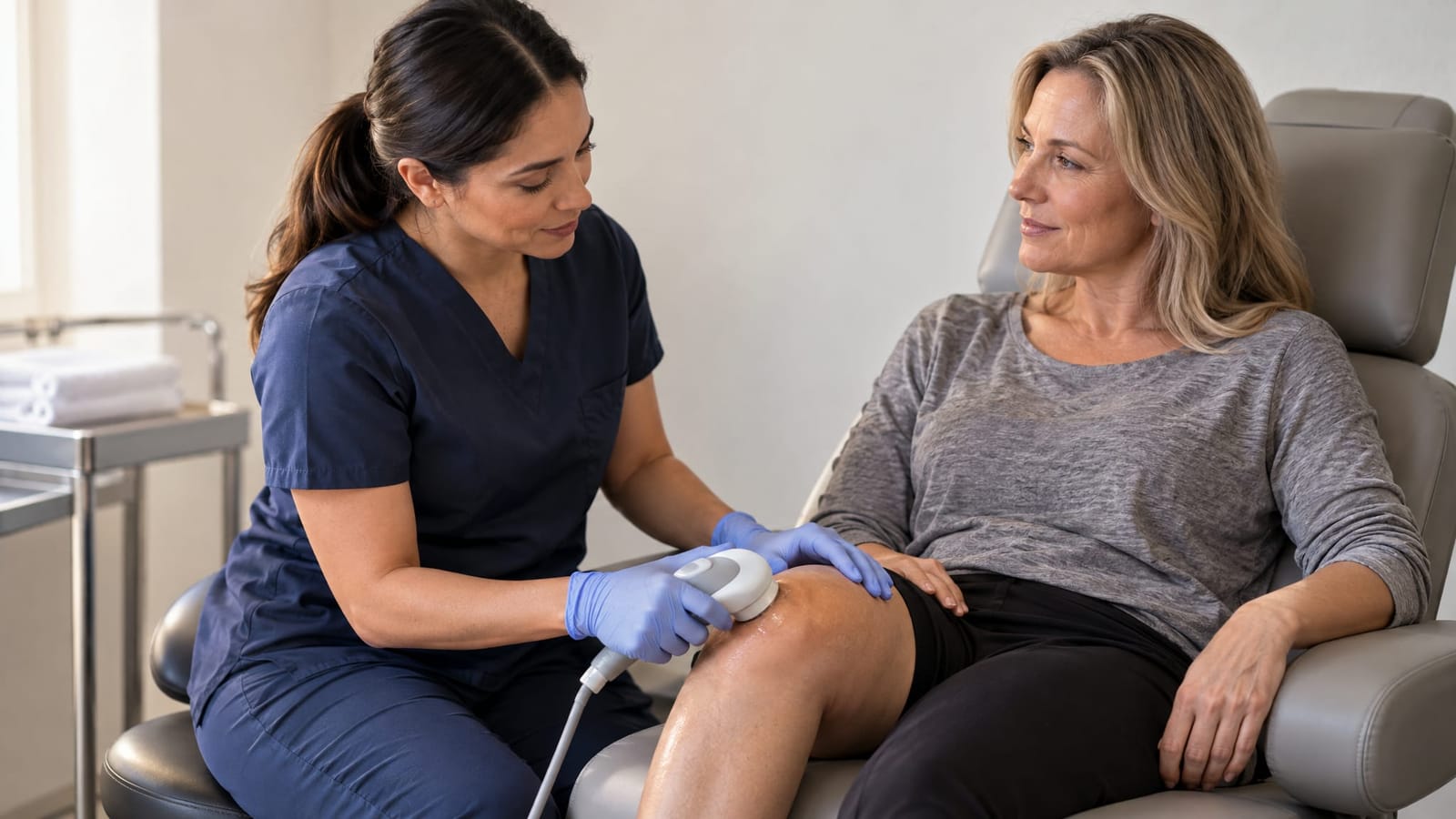
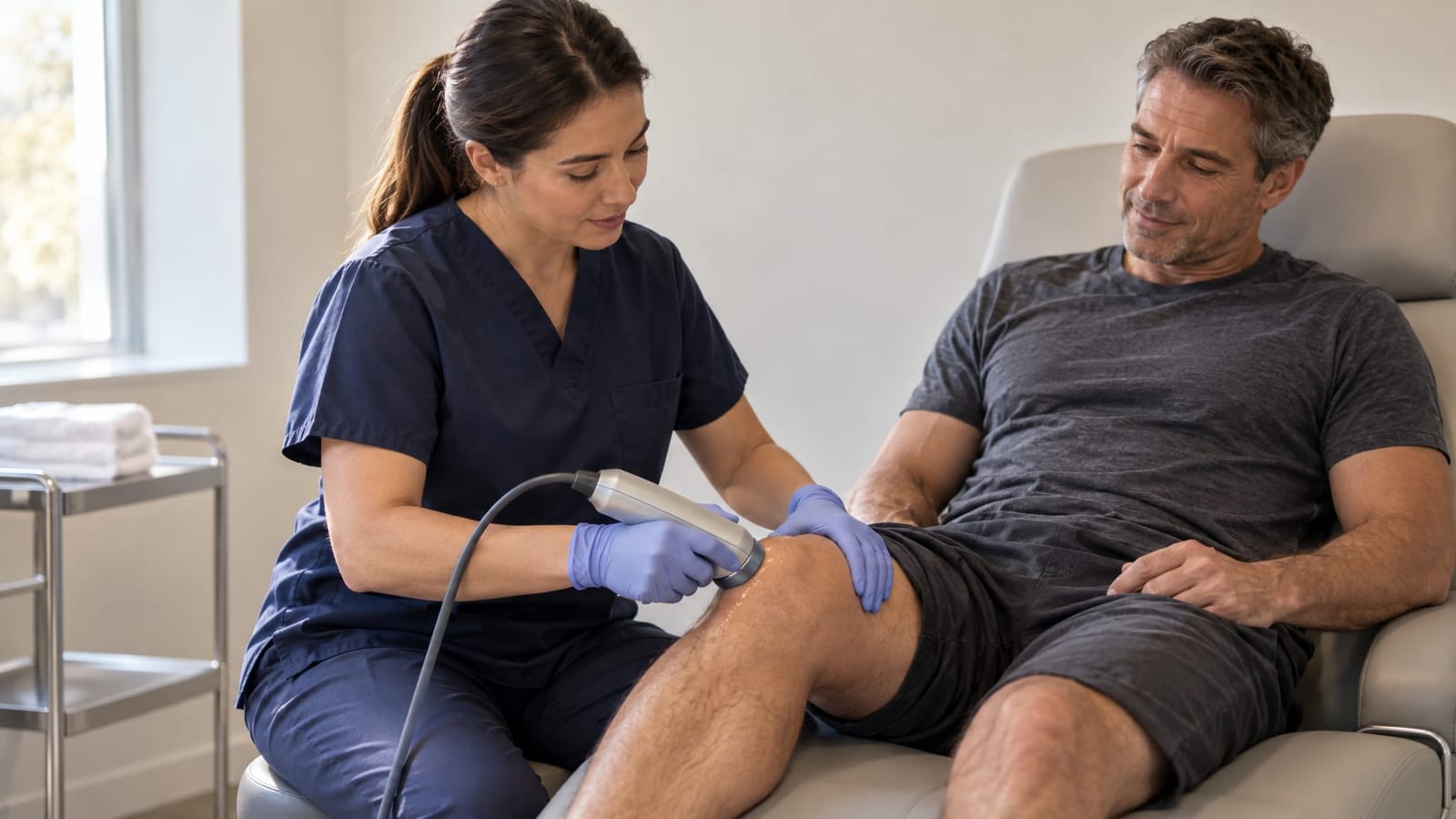
Shockwave therapy uses acoustic pressure waves to stimulate tissue at depth, increase local circulation, and disrupt calcifications or fibrotic tissue that can contribute to pain. When used before or alongside exosome injections, shockwave therapy may help prepare the joint environment to be more receptive to the biological signals delivered by exosomes: essentially opening the cellular "conversation" before the regenerative messengers arrive.
This combination approach reflects a broader principle in regenerative medicine: that stacking complementary therapies thoughtfully can amplify outcomes beyond what either modality achieves alone. At Chara, treatment protocols are not one-size-fits-all. Dr. Kong evaluates each patient's imaging, functional history, pain pattern, and overall health profile before recommending any specific combination of therapies. This level of individualization is central to the practice's philosophy.
Patients considering exosome therapy for knee pain in Los Angeles are encouraged to schedule a comprehensive consultation rather than arriving with a predetermined protocol in mind. The most effective treatment plans are built from a clinical assessment, not a menu.
Setting Realistic Expectations Before You Begin
One of the most important conversations in any regenerative medicine consultation is the one about realistic expectations. Exosome therapy for knee pain is not a guaranteed cure, and it is not appropriate for every patient or every stage of joint disease. Patients with very advanced structural knee damage, for example, may require a different primary intervention before regenerative therapies can meaningfully contribute.
That said, several factors tend to be associated with more favorable reported outcomes in clinical observations:
- Earlier-stage or moderate osteoarthritis rather than end-stage joint degeneration
- Active participation in rehabilitation and movement between treatments
- A broader lifestyle context that supports recovery, including nutrition, sleep, and inflammation management
- Consistent follow-up with the treating physician to assess progress and adjust the plan
Exosome therapy is also not a one-time event for most patients. Depending on the clinical assessment, a treatment series may be recommended, with timelines and frequency determined by the physician based on individual response. The goal is to support the joint's biological environment over time, not to force an outcome through a single intervention.
Frequently Asked Questions About Exosome Therapy for Knee Pain
How many exosome therapy sessions are typically needed for knee pain?
The number of sessions varies depending on the individual patient's condition, severity of joint involvement, and how they respond to initial treatment. Some patients undergo a single injection followed by monitoring, while others may benefit from a series of treatments over several months. A physician evaluation is essential to determining the right approach for your situation: there is no universal protocol.
How long does it take to notice results from exosome therapy for knee pain?
Most patients and practitioners describe a gradual improvement timeline rather than immediate relief. Observable changes in pain levels and mobility are often reported between 4 and 12 weeks following treatment, though individual timelines vary. The biological processes exosomes are thought to support, including inflammation modulation and tissue signaling, take time to produce meaningful functional change.
Is exosome therapy for knee pain safe?
Exosome therapy is considered minimally invasive, and the treatments performed at Chara Health use carefully sourced, high-quality exosome preparations administered under physician supervision. As with any medical procedure, potential risks exist and should be discussed in detail during a consultation with Dr. Kong or another qualified healthcare provider. This is not a procedure that should be sought outside of a clinical, physician-guided setting.
Can exosome therapy replace knee replacement surgery?
Exosome therapy is not a replacement for surgery in all cases and should not be positioned as such. For patients with severe structural joint damage, surgical options may still be the most clinically appropriate path. However, for those in earlier stages of knee degeneration or those who want to explore options before considering surgery, regenerative approaches like exosome therapy may be worth discussing with a physician as part of a broader care strategy.
Is Exosome Therapy the Right Next Step for Your Knee?
Exosome therapy for knee pain represents a genuinely compelling area of regenerative medicine: grounded in biological science, supported by a growing body of clinical observations, and increasingly integrated into thoughtful, physician-guided treatment programs. At Chara Health in Los Angeles, Dr. Joy Kong brings both the clinical expertise and the commitment to individualized care that this type of treatment requires. If you've been living with knee pain and are curious about what regenerative options might be appropriate for your situation, the most important first step is a comprehensive consultation, not a search for a protocol, but a conversation about your health. To learn more about the full scope of regenerative care available, explore our complete guide to exosome therapy in Los Angeles.