How Many Hair Restoration Sessions Do You Need at Chara Health?
If you're exploring regenerative hair restoration, one question comes up almost immediately: how many hair restoration sessions are needed to see real results? It's the right question to ask first. The honest answer is that it depends on you: your follicle health, your hair loss pattern, and your long-term goals. This guide explains exactly how Chara Health USA determines the right number of sessions for each patient. By the end, you'll have a clear picture of what your own treatment journey could look like, why the number of hair restoration sessions needed varies from person to person, and how to set realistic expectations before your first appointment.
Why the Number of Hair Restoration Sessions Needed Has No Single Answer
Most patients arrive expecting a fixed number. Three sessions. Six. Maybe twelve. The reality is more individualized than that. How many hair restoration sessions are needed varies from person to person based on biology, clinical history, and lifestyle. Understanding why helps you engage with the process as the personalized, physician-guided experience it truly is.
Research supports this individualized approach. A 2019 review in the Journal of Cutaneous and Aesthetic Surgery found that patients completing structured, multi-session protocols saw significantly greater hair density improvements than those receiving one or two standalone treatments. A study in Dermatologic Surgery confirmed that platelet-rich plasma therapy produced statistically significant hair count increases after three sessions, but the most robust improvements in thickness and density appeared after five or more sessions. The data consistently points to one conclusion: more sessions, properly spaced, produce better outcomes.
This is the core clinical principle: how many hair restoration sessions are needed is less about a single number and more about a thoughtfully designed sequence. At Chara Health USA, every protocol is built around that principle. The clinical team uses a five-phase model: assessment, initial series, response-based adjustment, maintenance, and long-term tracking. This ensures every patient receives exactly the number of hair restoration sessions their follicles actually need, with no guesswork and no one-size-fits-all packages.
Understanding this framework from the outset helps you make a fully informed decision about your care. It also prepares you for a process that rewards consistency, patience, and active participation, all hallmarks of the regenerative medicine approach Chara Health USA is built around.
How Many Hair Restoration Sessions Are Needed by Hair Loss Stage
Before diving into the full five-phase protocol, it helps to understand the general relationship between hair loss severity and the number of hair restoration sessions needed. This gives you a practical anchor as you read through the more detailed sections that follow.
Clinical staging, using the Norwood scale for men and the Ludwig scale for women, is one of the strongest predictors of total sessions required. Patients in the earliest stages of thinning typically need fewer sessions to achieve visible improvement. Those with more progressed hair loss require a longer, more intensive series to reactivate dormant follicles and build meaningful density. Here is a general framework based on the staging model used at Chara Health USA:
- Mild thinning (Norwood I: III / Ludwig I): Approximately 3-4 initial sessions, with maintenance every 5-6 months. Follicles are more likely to be active and recoverable, making regenerative therapy highly effective at this stage.
- Moderate thinning (Norwood IV: V / Ludwig II): Approximately 4-6 initial sessions, with maintenance every 4-5 months. More progressed dormancy requires deeper regenerative support before visible improvements emerge.
- Advanced thinning (Norwood VI: VII / Ludwig III): 6 or more initial sessions, often combined with adjunctive therapies such as peptide protocols or hormonal optimization. Expectations are discussed honestly at the outset, reflecting what is realistically achievable at this stage.
- Patients with prior treatment history: Prior use of minoxidil, conventional PRP, or laser therapy affects follicle sensitivity and must be accounted for in protocol design. How many hair restoration sessions are needed in these cases is assessed individually based on your specific history.
These ranges are clinical starting points, not guarantees. Your actual protocol is determined through a comprehensive assessment at Chara Health USA, not assumed from a generalized chart. Every patient's biology is different, and the most accurate answer to how many hair restoration sessions are needed for you comes from a direct clinical evaluation.
Phase 1: The Comprehensive Follicle Assessment That Determines Your Starting Point
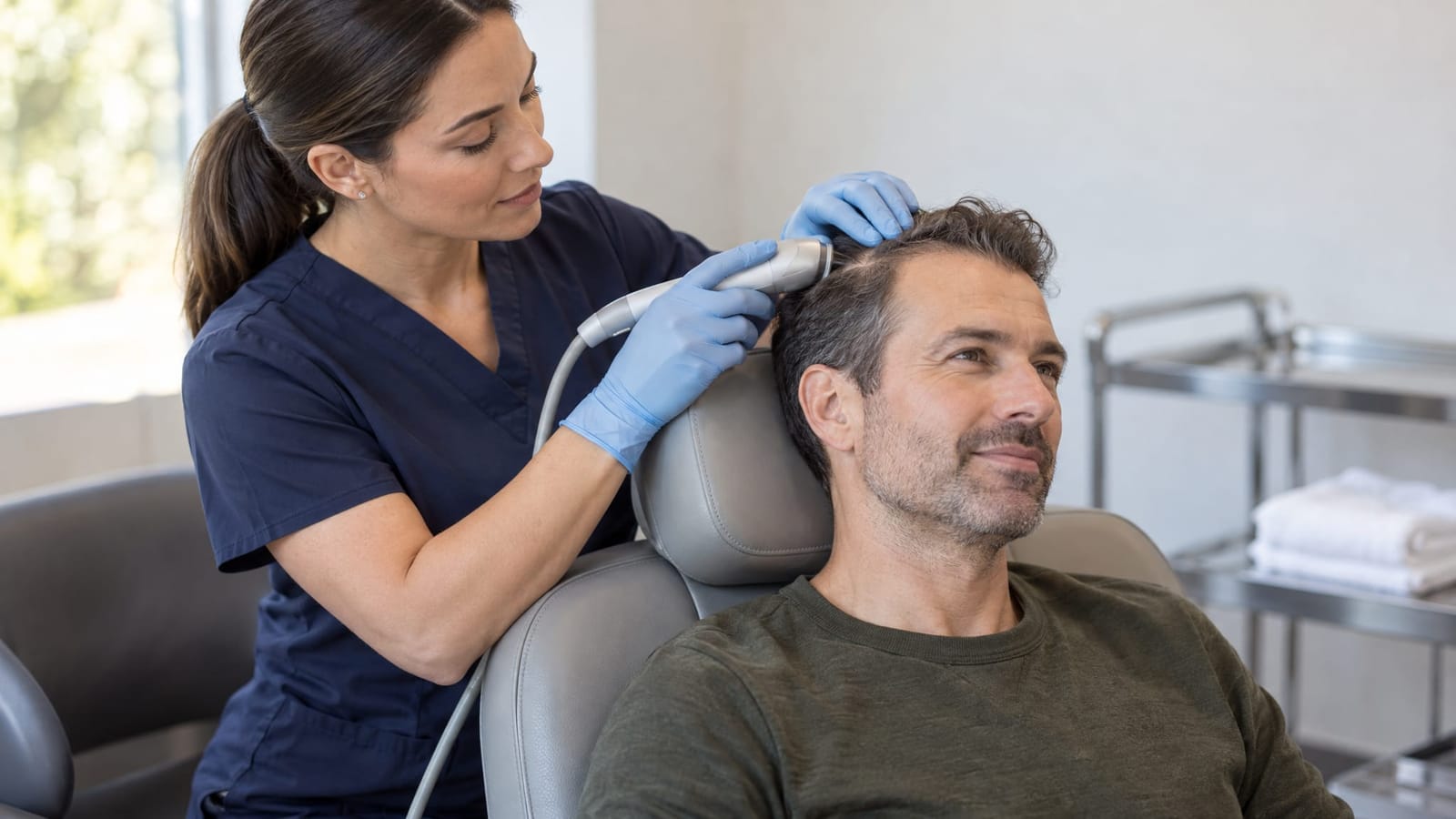
No sessions are scheduled before a thorough clinical evaluation. At Chara Health USA, this is a 45- to 60-minute consultation, not a quick visual scan. Your provider reviews your complete medical history, assesses hair loss severity and pattern, and investigates contributing factors like hormonal shifts, nutritional deficiencies, thyroid function, and chronic stress. The result is a personalized protocol built around your clinical profile, not a generic menu of treatment options.
This foundational step directly shapes how many hair restoration sessions are needed for your specific case. Someone in the early stages of diffuse thinning may need a shorter initial series. A patient with advanced follicle miniaturization or a longer history of hair loss typically needs additional sessions to achieve meaningful change. There is no universal package: the assessment comes first precisely because individual variation is so significant.
Your assessment also establishes a documented baseline. Without this starting point, tracking progress objectively over time is impossible. The baseline is what Chara Health USA uses to measure whether your follicles are responding, and to confirm when you've achieved the results you came for. It's the foundation of accountable, evidence-based care.
What the Initial Consultation Evaluates
Your Chara Health USA provider will assess each of the following during your first visit. Each factor directly informs how many hair restoration sessions are needed and how those sessions should be structured:
- Hair loss classification: Using the Norwood scale (men) or Ludwig scale (women) to categorize the stage and distribution of thinning. This classification is one of the strongest predictors of total sessions required.
- Follicle miniaturization: Determining how many follicles remain active versus dormant. Dormant follicles can still respond to regenerative therapy, but they typically require more sessions to reactivate than follicles that are still cycling.
- Scalp circulation and tissue health: Regenerative therapies work by supporting cellular signaling in the scalp environment. Poor circulation can slow follicle response and increase the total number of hair restoration sessions needed to achieve visible improvement.
- Hormonal and nutritional markers: DHT, estrogen, thyroid hormones, iron, zinc, biotin, and vitamin D levels all influence follicle health. Deficiencies or imbalances are addressed as part of the protocol to maximize treatment response.
- Prior treatment history: Previous use of minoxidil, finasteride, conventional PRP, or laser therapy affects follicle sensitivity and informs how many hair restoration sessions are needed in your case and how the new protocol is structured.
- Stress load and sleep patterns: Chronic stress elevates cortisol, which can push follicles prematurely into the resting phase. This systemic factor directly affects how quickly follicles respond to treatment and how many sessions are required to produce stable improvement.
This level of clinical rigor reflects Chara Health USA's commitment to regenerative medicine as a serious, evidence-informed discipline, not a cosmetic shortcut offered off a menu. It's the difference between a treatment experience and a medical one.
Phase 2: The Initial Hair Restoration Treatment Series: How Many Sessions Are Needed and Why
After your assessment, you begin the foundational phase: an initial series of sessions spaced approximately four to six weeks apart. Most patients need between three and six hair restoration sessions in this phase before noticing meaningful improvements in hair density and scalp coverage. The exact number within that range is determined by your assessment results and how your scalp responds after early sessions: making this a dynamic process, not a fixed schedule.
Why are multiple hair restoration sessions needed rather than one treatment? Follicle regeneration is a biological process. It unfolds gradually over weeks and months. Hair growth cycles, anagen (growth), catagen (transition), and telogen (rest), span several months. Regenerative therapies work by supporting the follicle environment over time, not by delivering a single chemical trigger. Spacing sessions four to six weeks apart allows regenerative activity to build cumulatively between appointments. Each session reinforces the last, creating an effect that compounds over time.
A 2022 meta-analysis in the Journal of Dermatological Treatment reviewed 19 clinical trials on regenerative hair therapies and found that protocols with five or more hair restoration sessions consistently outperformed shorter protocols in both hair density and patient satisfaction scores. A separate review published in Aesthetic Plastic Surgery reported average hair count increases of 30-40% in patients who completed structured multi-session protocols versus 10-15% in those receiving fewer than three sessions. This is why Chara Health USA uses a multi-session model as its clinical standard, because the biology of hair growth demands it.
What Patients Typically Experience Session by Session
Here is a general breakdown of the experience during the initial series at Chara Health USA. Individual timelines vary, but this reflects what most patients report across a standard three-to-six-session initial protocol:
- Sessions 1-2: The scalp's follicle environment begins receiving regenerative signaling. Most patients don't notice visible changes yet. However, reduced shedding within the first four to six weeks is a common early indicator that follicles are responding positively. Scalp comfort and circulation often improve during this window as well.
- Sessions 3-4: Early improvements in scalp coverage and hair texture often become noticeable here. Hair may appear fuller and more resilient. New growth may begin emerging in areas of prior thinning. This is often when patients feel the answer to how many hair restoration sessions are needed becoming clearer, because visible progress validates the commitment they've made.
- Sessions 5-6 (when applicable): For patients with moderate to advanced thinning, additional sessions reinforce follicle responsiveness and support density in areas needing more intensive regenerative support. Your Chara Health USA provider will assess whether these sessions are clinically warranted based on your response data at each visit, not a preset package.
Set realistic timelines from the start. Most patients notice early changes around the three-month mark. More visible improvements in thickness and density typically appear between four and six months into a consistent series. Hair restoration is a long-term investment, not a quick fix. Patients who achieve the best outcomes understand and embrace this reality from day one.
Why Session Spacing Matters as Much as Session Count
The interval between sessions is not arbitrary. Spacing hair restoration sessions four to six weeks apart aligns with the follicle's natural regenerative cycle. Treating too frequently doesn't accelerate results: it can actually overwhelm the follicle environment before it has fully processed the previous session's regenerative signals. Treating too infrequently allows momentum to dissipate between appointments.
This balance between frequency and timing is one of the most important, and most frequently overlooked, aspects of how many hair restoration sessions are needed. At Chara Health USA, session intervals are calibrated to your follicle response at each visit. If your follicles are responding strongly, intervals may be extended. If progress is slower, the care team will discuss whether closer spacing could accelerate response for your specific situation.
How Hair Loss Severity Determines How Many Hair Restoration Sessions Are Needed
Hair loss severity plays a significant role in determining the total number of sessions required. At Chara Health USA, severity classification is one of the most important inputs into your protocol design. Below is a more detailed clinical breakdown that helps patients understand where they fall, and what that means for their treatment plan.
- Mild thinning (Norwood I: III / Ludwig I): Follicles are more likely to be active or recoverable. Regenerative therapy can often produce measurable improvement within three to four sessions. Total sessions needed in the initial phase are typically at the lower end of the three-to-six range, and maintenance intervals can often be extended comfortably.
- Moderate thinning (Norwood IV: V / Ludwig II): More progressed hair loss or prolonged follicle dormancy usually requires five to six initial sessions. Progress may be more gradual as the follicle environment needs deeper regenerative support before responding visibly. Patience and consistency are especially important at this stage.
- Advanced thinning (Norwood VI: VII / Ludwig III): Patients at this stage typically benefit from a longer initial series. They may also incorporate adjunctive therapies, peptide support, targeted nutritional protocols, or hormonal optimization, alongside primary regenerative sessions. Chara Health USA providers are transparent about what is realistically achievable at each stage, setting honest expectations from the outset.
- Patients with prior treatment history: If you've used minoxidil, traditional PRP, or other therapies without satisfying results, prior treatments may affect follicle sensitivity and the overall follicle environment. Your provider will account for this when estimating how many hair restoration sessions are needed and will structure a more targeted approach based on your specific history.
Adjustments are made based on clinical evidence at every step. If your follicle response after the first two or three sessions shows strong progress, your provider may adjust the timeline accordingly. If response is slower, they'll discuss modifications, additional sessions, adjusted intervals, or complementary therapies, that better support your goals and optimize your total treatment investment.
How the Regenerative Modality Affects the Number of Hair Restoration Sessions Needed
The specific approach used also influences how many hair restoration sessions are needed. Conventional PRP therapies and more advanced exosome-based treatments differ meaningfully, in their mechanisms of action, in the concentration of growth factors delivered, and in their capacity for sustained follicle signaling after each session.
Exosome-based therapies deliver a significantly higher concentration of extracellular signaling molecules than conventional PRP. Some clinical data suggests this supports stronger follicle activation per session. For some patients, this may allow comparable results in a shorter initial series, potentially reducing the total number of hair restoration sessions needed to achieve visible density improvements. This is highly individual, however, and your Chara Health USA provider will guide the modality decision based on your assessment findings, not a generalized assumption or price point.
Combination approaches, pairing exosome therapy with peptide protocols or nutritional optimization, are also available at Chara Health USA for patients who want a comprehensive, multi-mechanism strategy. These combinations can sometimes accelerate response and reduce the total number of sessions needed in the initial phase, while also extending the durability of maintenance results. Your provider will discuss whether a combination protocol is appropriate for your clinical profile during your initial consultation.
Phase 3: Response-Based Adjustments: When Protocols Change Mid-Series
One of the most important features of care at Chara Health USA is that protocols are never locked in. After each session, your provider evaluates your follicle response using objective measurements and clinical observation. If you're progressing faster than expected, session intervals can be extended or the initial series shortened. If progress is slower, the protocol can be intensified, modified, or supplemented.
This adaptive model is a core part of the answer to how many hair restoration sessions are needed, because it ensures you receive precisely what your biology requires at each stage of the process. Objective measurements guide these decisions. Trichoscopic imaging, hair density assessments, and standardized photography are taken at each appointment. Your provider compares these images and measurements to your baseline and prior visits. Changes in hair shaft caliber, which often improve before density changes become visible, are tracked as early markers of follicle responsiveness.
This kind of mid-protocol assessment is rarely available at standalone cosmetic treatment clinics. It is a defining feature of Chara Health USA's physician-guided regenerative medicine model. It means your care evolves with you throughout the process, not a fixed service delivered identically to every patient regardless of how they're responding.
Phase 4: Maintenance Sessions: Why the Number of Hair Restoration Sessions Needed Extends Beyond the Initial Series
Completing your initial series is a meaningful milestone. But it is not the finish line for patients who want long-term results. Hair follicles continue to face the same genetic, hormonal, and environmental pressures that caused thinning in the first place. This is a critical reason why understanding how many hair restoration sessions are needed must extend beyond the initial series, because maintenance is not optional if you want to preserve what you've built.
Most patients at Chara Health USA transition to a maintenance schedule after the initial series. Appointments are typically spaced every four to six months. This interval reflects the natural rhythm of the hair growth cycle and the duration of regenerative effects observed in clinical practice. Your specific maintenance frequency is determined by how well your follicles responded and how stable your results are at the end of the initial series, not a generic calendar.
Research supports this long-term approach. A study in the International Journal of Trichology found that patients maintaining consistent follow-up treatments after an initial series showed significantly better long-term hair density outcomes than those who discontinued care after achieving initial results. A separate longitudinal study tracked patients over 24 months and found that those who attended regular maintenance sessions maintained an average of 85% of their peak hair density improvements, compared to 40% in those who stopped treatment entirely. Think of maintenance sessions like other preventive health investments: they're not about fixing a returning problem, but about preserving and extending progress already made.
Signs Your Maintenance Schedule May Need Adjustment
During maintenance visits, your Chara Health USA provider reassesses your scalp at each appointment. Several factors may indicate that your maintenance interval should be shortened or your protocol adjusted. Recognizing these signals early is one of the most important ways to protect the results you've achieved:
- New areas of thinning emerging between scheduled appointments
- Seasonal shedding that is more pronounced than in prior years
- Hormonal changes, including menopause, postpartum recovery, or thyroid fluctuations, that may accelerate hair loss cycles
- Elevated or sustained stress levels, which can push follicles prematurely into the telogen (resting) phase and trigger shedding
- Nutritional gaps developing due to dietary changes, illness, or shifts in absorption
- Introduction of medications known to affect hair cycling or follicle health
- Significant changes in scalp health, such as increased inflammation or dermatitis flares
This proactive monitoring model is one of the strongest differentiators of Chara Health USA's approach. Ongoing assessment allows the care team to intervene early, before minor changes become significant setbacks. Patients who stay engaged with their maintenance schedule consistently report more stable, lasting results than those who discontinue care after the initial series and return only when they notice visible deterioration.
Phase 5: Long-Term Progress Tracking Across Every Hair Restoration Session
At Chara Health USA, structured objective tracking runs throughout your entire hair restoration journey. Rather than relying solely on how your hair looks in the mirror, your provider uses standardized measurements to evaluate follicle response at every stage. This approach answers how many hair restoration sessions are needed with evidence, not estimation, and gives you a clear, documented record of your progress from first session to long-term maintenance.
Progress tracking at Chara Health USA typically includes the following measurements at each appointment:
- Standardized scalp photography: High-resolution images from consistent angles at each appointment, allowing direct visual comparison of hair density and coverage over time. Comparing session-to-session images removes the ambiguity of subjective perception.
- Trichoscopic hair density assessment: Quantitative measurement of hair count per square centimeter in targeted areas, providing an objective marker of follicle response that is independent of lighting, styling, or patient perception.
- Hair shaft caliber evaluation: Assessment of changes in hair thickness and diameter. Shaft caliber often improves before density changes become clearly visible, giving the care team early confirmation that regenerative activity is occurring at the follicle level.
- Patient-reported outcome measures: Structured self-assessment of shedding patterns, scalp comfort, and perceived fullness. These complement clinical data with your lived experience of the process and help identify discrepancies between objective and subjective response.
These measurements serve two purposes. First, they allow the care team to make data-informed decisions about your protocol: extending the initial series, adjusting intervals, or adding complementary therapies as needed. Second, they give you a clear visual record of your progress. Many patients find that seeing objective evidence of follicle improvement, even before it's clearly visible in the mirror, helps sustain commitment to the full series. That commitment is one of the strongest predictors of final outcome, regardless of how many hair restoration sessions are ultimately needed.
Additional Factors That Influence How Many Hair Restoration Sessions You'll Need
Beyond severity and modality, several additional factors influence the total number of hair restoration sessions needed. Chara Health USA's clinical team considers all of these when designing and refining your protocol. Understanding these variables helps you actively support your own treatment, and get the most from every session.
- Age: Follicle regenerative capacity tends to decline with age. Older patients may require more hair restoration sessions to achieve outcomes comparable to younger patients with similar hair loss severity. Early intervention, before advanced miniaturization occurs, consistently produces faster, more robust results.
- Genetics: Family history of androgenetic alopecia influences how quickly hair loss progresses and how aggressively it must be managed. This affects both initial series length and long-term maintenance planning. Knowing your family history helps your provider set realistic expectations for what's achievable with regenerative care.
- Hormonal health: Active hormonal imbalances, including elevated DHT, estrogen dominance, or thyroid dysfunction, can counteract regenerative efforts if not addressed concurrently. Your Chara Health USA provider will discuss whether hormonal optimization should be incorporated into your protocol as a foundational element of care.
- Stress and sleep quality: Chronic stress is one of the most underappreciated drivers of hair loss. Elevated cortisol can trigger telogen effluvium and slow follicle recovery between sessions. Patients who actively manage stress and prioritize restorative sleep tend to respond more favorably and often require fewer total hair restoration sessions to achieve their goals.
- Nutritional status: Deficiencies in iron, zinc, biotin, vitamin D, and protein directly impair follicle function and limit response to regenerative therapy. Addressing these gaps, through targeted dietary changes or physician-guided supplementation, can meaningfully improve how many hair restoration sessions are needed to produce visible results. At Chara Health USA, nutritional assessment is integrated into your baseline evaluation.
- Treatment consistency: Patients who attend sessions on schedule and follow their provider's adjunctive recommendations achieve better outcomes than those with significant gaps between appointments. Skipping or delaying sessions may require additional treatments to recover lost regenerative momentum. Consistency is arguably the single most controllable factor in how many hair restoration sessions are ultimately needed.
- Scalp health at baseline: Conditions such as seborrheic dermatitis, significant scalp inflammation, or chronic product buildup can impair follicle responsiveness and reduce the impact of each session. Addressing these issues before or during the treatment series improves outcomes and may reduce the total number of sessions needed.
- Overall systemic health: Metabolic health, inflammatory burden, sleep quality, and cardiovascular fitness all influence the scalp's tissue environment. Patients who invest in comprehensive health optimization alongside their hair restoration protocol consistently report stronger and faster results: reflecting the broader philosophy of regenerative medicine that Chara Health USA practices.
What Patients Say: Real Experiences With Hair Restoration Session Counts
Clinical data tells one part of the story. Patient experience fills in the rest. At Chara Health USA, patients consistently report that their understanding of how many hair restoration sessions are needed evolved as they moved through the process, and that the ongoing communication with their provider was central to their confidence and commitment throughout.
One patient who came in at a Norwood III classification, moderate frontal recession with diffuse crown thinning, completed four initial sessions over a 16-week period. By session three, she noticed reduced daily shedding. By session four, her trichoscopic assessment showed an 18% increase in hair density in the frontal zone. She transitioned to a maintenance schedule of one session every five months and has maintained her results consistently for over 18 months.
Another patient arrived having already tried conventional PRP at a different clinic with disappointing results. His Chara Health USA assessment revealed significant nutritional gaps and suboptimal scalp circulation: factors his prior clinic had not evaluated. His protocol was restructured around an exosome-based approach with nutritional support and peptide integration. He required six initial sessions rather than four, but achieved measurable density improvements that had eluded him through prior treatment. His experience reflects a common pattern: how many hair restoration sessions are needed often comes down less to the treatment itself and more to the thoroughness of the assessment behind it.
These experiences are representative of outcomes that depend on individual biology, consistency, and clinical expertise. They are not guarantees. But they reflect the kind of patient journey that Chara Health USA's physician-guided model is designed to support: transparent, adaptive, and built around real data rather than fixed packages.
Frequently Asked Questions: How Many Hair Restoration Sessions Are Needed?
How soon will I see results from hair restoration sessions?
Hair growth is a gradual biological process. Most patients begin to notice early improvements, reduced shedding, improved scalp coverage, or increased hair thickness, around the three-month mark. More visible changes in density typically appear between four and six months into a consistent series at Chara Health USA. Individual timelines vary based on hair loss severity, follicle responsiveness, and the specific regenerative modality used. Results that develop gradually tend to be more stable and lasting than rapid cosmetic changes produced by surface-level treatments.
Can I skip maintenance sessions once my initial series is complete?
Completing the initial series is an important achievement. But discontinuing care afterward often leads to a gradual decline in the improvements you've worked to achieve. Hair follicles continue to face the same genetic, hormonal, and environmental pressures that caused thinning in the first place. Maintenance sessions, typically every four to six months at Chara Health USA, sustain follicle health and preserve results over the long term. Your provider will help you determine what maintenance frequency makes sense for your specific situation and goals.
Does the number of hair restoration sessions needed differ for men and women?
Hair loss patterns and underlying causes differ between men and women in important ways. Male pattern baldness typically follows the Norwood progression and is often driven by DHT sensitivity. Female hair loss is frequently more diffuse and may involve hormonal, nutritional, autoimmune, or stress-related components. The foundational framework, a personalized initial series followed by ongoing maintenance, applies to both. The specific number of hair restoration sessions needed is individualized based on your clinical assessment, not gender alone. Women with hormonally-driven hair loss may also benefit from concurrent hormonal optimization as part of their protocol.
What if I've already tried PRP or other treatments without satisfying results?
Prior treatment history is an important part of your initial evaluation at Chara Health USA. If you've undergone conventional PRP or used topical medications without satisfying results, your provider will take that into account when designing a more targeted protocol. Advanced options, including exosome-based therapies, peptide support, and combination approaches, may address mechanisms that prior treatments missed or underserved. Your prior history doesn't disqualify you from achieving meaningful results. It informs how your Chara Health USA provider designs a better, more individualized path forward.
Is it possible to need fewer hair restoration sessions than initially anticipated?
Yes. Some patients respond more robustly than expected in early sessions. Their Chara Health USA providers may extend the interval between treatments or determine the initial series can be completed in fewer sessions than originally projected. This is a key advantage of the ongoing assessment model: your protocol is never locked in from the outset. It evolves in real time in response to your actual follicle behavior, ensuring you receive precisely the number of hair restoration sessions needed and not more.
How many hair restoration sessions are needed in the first year total?
For most patients at Chara Health USA, the first year includes an initial series of three to six sessions plus one to two maintenance appointments depending on timing. This puts the total number of hair restoration sessions needed in year one at approximately five to eight. After year one, most patients require only two to three maintenance sessions annually to preserve and build on their results. This long-term cadence reflects the biological rhythm of hair follicle cycling, and it's designed to sustain your investment over time, not require perpetual intensive treatment.
What is the typical cost investment for a full hair restoration protocol?
Investment varies depending on the number of sessions in your initial series, the regenerative modality selected, and whether adjunctive therapies are incorporated. Chara Health USA provides transparent pricing during the initial consultation, after your clinical assessment determines the appropriate protocol. Because the number of hair restoration sessions needed is individualized, pricing is discussed in that context, not as a fixed package before your clinical needs are understood. Many patients find that a physician-guided protocol is a more efficient long-term investment than repeated trial-and-error with over-the-counter solutions.
Quick-Reference Summary: How Many Hair Restoration Sessions Are Typically Needed?
For patients who want a concise overview before diving into a full consultation, here is a practical summary of the session framework most commonly used at Chara Health USA. These ranges are clinical generalizations: your individual protocol will be determined through assessment, not assumed from this summary.
- Initial assessment: 1 comprehensive consultation (45-60 minutes) to establish baseline and determine how many hair restoration sessions are needed
- Mild thinning (Norwood I: III / Ludwig I): 3-4 initial sessions spaced 4-6 weeks apart
- Moderate thinning (Norwood IV: V / Ludwig II): 4-6 initial sessions spaced 4-6 weeks apart
- Advanced thinning (Norwood VI: VII / Ludwig III): 6+ initial sessions, often with adjunctive therapies incorporated
- Early results window: Most patients notice initial improvements at 3 months; clearer density improvements at 4-6 months
- Maintenance phase: Sessions every 4-6 months following the initial series, adjusted based on ongoing follicle response
- Protocol adjustments: Made at every visit based on objective tracking data, not predetermined at the outset
- Total first-year sessions (typical): 5-8 sessions, including initial series and first maintenance appointment
- Annual maintenance sessions (after year one): 2-3 sessions per year for most patients with stable results
These numbers provide useful context. They are not guarantees. Your actual protocol will be determined by the clinical team at Chara Health USA based on your individual assessment findings and follicle response data gathered throughout your treatment journey.
Why Patients Choose Chara Health USA for Regenerative Hair Restoration
Chara Health USA is a physician-led regenerative medicine practice serving patients who take a proactive, evidence-informed approach to their long-term health. The clinical team brings direct expertise in regenerative therapies, including advanced exosome-based protocols, peptide integration, hormonal optimization, and comprehensive nutritional support, all directly relevant to hair restoration care that works at the biological level.
What distinguishes Chara Health USA is not just the therapies offered, but the model of care surrounding them. Every patient receives a documented baseline assessment, ongoing objective progress tracking, and a protocol that evolves based on actual follicle response data. This is not a cosmetic spa model. It is a medical model: one built for patients who want to understand their biology, invest in outcomes that last, and work with providers who prioritize transparency and clinical accountability.
Patients who come to Chara Health USA often arrive after trying other approaches without satisfying results. Many report that the personalized assessment and adaptive protocol, rather than a preset treatment package, was the difference that finally made their hair restoration journey successful. The clinical team's commitment to honest communication about realistic timelines and how many hair restoration sessions are needed builds the trust that sustains patients through a process that requires consistency, patience, and genuine engagement. That kind of relationship-centered care is central to everything Chara Health USA does.
Chara Health USA patients are also typically invested in their broader health, not just their hair. The regenerative medicine approach integrates hormonal health, metabolic function, nutritional optimization, and stress management into the hair restoration protocol. This whole-person philosophy means that patients often experience benefits that extend well beyond hair density alone, including improved energy, better sleep quality, and enhanced overall vitality. It's the kind of care that treats the root cause, not just the visible symptom.
Setting Realistic Expectations Before Your First Hair Restoration Appointment
The number of hair restoration sessions needed is never fixed before your first appointment. It is a clinical picture that emerges through careful assessment, thoughtful treatment planning, and ongoing monitoring of follicle response over time. Most patients at Chara Health USA benefit from an initial series of three to six sessions spaced four to six weeks apart, followed by periodic maintenance every four to six months to preserve results.
Patients with more advanced hair loss, complex health histories, or slower follicle response may require a more extended protocol. That extended investment typically yields proportionally meaningful results, and the research is clear that structured, multi-session protocols consistently outperform standalone treatments in both density outcomes and patient satisfaction. Knowing precisely how many hair restoration sessions are needed before you begin isn't possible without a clinical evaluation, but understanding the framework gives you a meaningful foundation for realistic planning.
Understanding how many hair restoration sessions are needed is ultimately about understanding yourself: your biology, your history, and your goals. The patients who achieve the most satisfying, lasting outcomes are those who commit fully to the process. That means completing the assessment, attending the initial series consistently, maintaining the follow-up schedule, and actively engaging with the ongoing monitoring that keeps your protocol precisely aligned with your evolving needs.
At Chara Health USA, the regenerative hair restoration model is built for exactly this kind of thoughtful, individualized, long-term care. If you're considering hair restoration and want to understand what a physician-guided, evidence-informed approach looks like in practice, and what it means for how many hair restoration sessions are needed in your specific case, a consultation is the most informed first step you can take. The answer starts with a conversation. That conversation starts here.